
Key points:
- Goldman shares slump 2%
- Equities revenue hits record
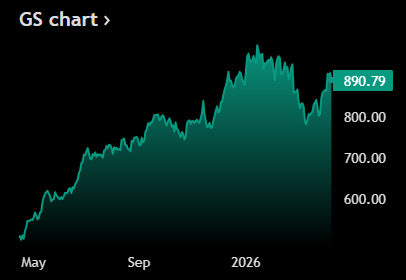
- Stock 10% off from record high
Goldman’s traders once again turned up and showed how it’s done. A 27% rise to a record $5.3 billion.
📊 Strong Quarter, Weak Stock Reaction
- Shares of Goldman Sachs GS slipped nearly 2% Monday even after the bank posted earnings of $17.55 per share, beating estimates of $16.49. Revenue reached $17.2 billion, also ahead of expectations — solid numbers that somehow still didn’t impress traders.
- Net profit rose 19% year over year to $5.63 billion, marking Goldman’s second-highest quarterly revenue on record. Normally that earns applause. This time, the market responded with a polite shrug and a lower share price.
- The stock now sits roughly 10% below its record high, suggesting investors are demanding not just strong results — but flawless ones — from Wall Street’s most performance-sensitive names.
💹 Equities Desk Steals the Show
- Goldman’s equities trading division delivered a record $5.3 billion in revenue, up 27% from a year earlier and about $420 million above expectations. Hedge fund financing and heavy activity in cash equities helped power the standout performance.
- Equities trading means facilitating large institutional stock transactions and financing strategies for funds. When markets churn around themes like artificial intelligence disruption, trading desks often become profit engines — and Goldman’s ran hot this quarter.
- The result helped push overall firm revenue toward the top end of historical ranges, reinforcing Goldman’s reputation as one of Wall Street’s most consistent trading franchises during volatile market cycles.
📉 Fixed Income Miss Spoils the Party
- Not everything fired on all cylinders. Fixed income revenue dropped 10% to $4 billion, missing expectations by roughly $910 million — a rare stumble for a division that usually balances out equities volatility.
- Weak performance in interest-rate products, mortgages and credit trading dragged on results. In banking terms, fixed income covers bonds and rate-sensitive instruments — markets that can swing sharply when policy expectations shift.
- Investment banking helped offset some of the weakness, with fees jumping 48% to $2.8 billion on strong merger advisory activity and underwriting. Still, investors focused on what missed rather than what beat — and the stock paid the price.

No responses yet