
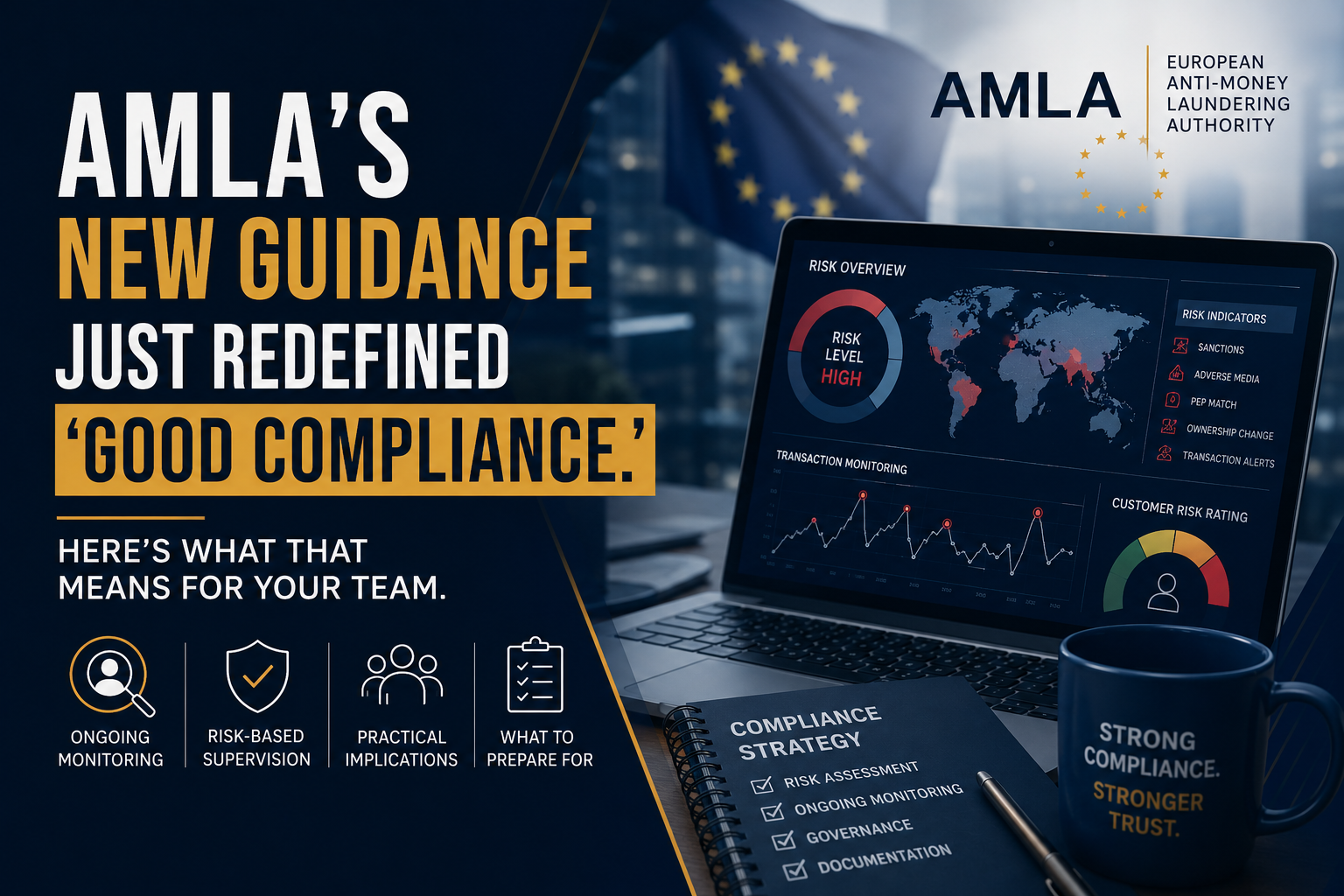
For years, AML compliance ran on a simple logic: onboard the customer, check the boxes, file the review, move on. The European Anti-Money Laundering Authority (AMLA) just made clear that this era is ending.
Its latest guidance on ongoing monitoring and risk-based supervision doesn’t just tweak a few requirements, it shifts what “compliant” actually means. Static, point-in-time due diligence is out. Continuous, risk-aware monitoring is in. And organizations that start adapting now will have a real head start when supervisors come knocking.
Why This Guidance Matters Now
Risk doesn’t sit still. Customer relationships evolve, ownership structures shift, new products launch, and bad actors get more creative every quarter. AMLA’s guidance simply catches up with that reality by reinforcing a principle compliance professionals have known for a long time: due diligence isn’t a one-and-done task, it’s an ongoing discipline.
Instead of leaning on whatever information was gathered at onboarding, firms are now expected to keep asking whether customer data, transaction patterns, and risk classifications still hold up. That’s a meaningful shift, from periodic check-ins to continuous risk awareness.
Ongoing Monitoring: From “Nice to Have” to Core Expectation
Good monitoring catches problems while they’re still small. Under AMLA’s framework, that means regularly checking whether:
- Customer information is still accurate
- Transaction activity still matches the customer’s expected profile
- Beneficial ownership structures have changed
- New sanctions hits, adverse media, or regulatory red flags have surfaced
- The customer’s risk rating still reflects who they actually are today
None of this is about hoarding more data for its own sake. It’s about making sure every compliance decision is grounded in information that’s actually current, not a snapshot from three years ago.
What Risk-Based Supervision Really Means
Not every customer or product carries the same risk, and AMLA’s guidance leans hard into that fact. Supervisors are increasingly asking whether firms are putting their compliance resources where the risk actually is, not spreading identical controls across every relationship regardless of exposure.
In practice, that looks like:
- Enhanced Due Diligence (EDD) for higher-risk customers
- More frequent reviews on high-risk relationships
- Closer monitoring of complex ownership structures
- Extra scrutiny for higher-risk jurisdictions
- Controls tailored to specific products, services, and delivery channels
The bar isn’t just “do you have controls.” It’s “can you explain why these controls fit these risks.”
Five Questions Every Compliance Team Should Be Asking Right Now
1. Is our enterprise-wide risk assessment still accurate?
Business models move fast. If your risk assessment hasn’t caught up with new products, markets, or technologies, it’s already out of date.
2. Are customer risk ratings actually being reviewed, or just carried forward?
A customer shouldn’t keep the same risk rating for five years simply because nobody revisited it. Regular reassessment keeps monitoring aligned with real risk, not historical assumptions.
3. Can your monitoring systems spot what actually matters?
Technology should surface meaningful change and unusual behavior, not bury your team in false positives that make real risk harder to see.
4. Is accountability actually clear across the business?
Strong compliance isn’t a department problem. It requires real coordination between business units, senior management, risk, and compliance teams, with clear ownership at each step.
5. Would your documentation hold up under scrutiny?
Supervisors want to see the “why” behind decisions, not just the decision itself. Well-documented risk assessments and monitoring rationale are no longer optional extras.
What to Do Before the Next Review
You don’t need to wait for more guidance to start closing gaps. A few moves worth making now:
- Revisit your enterprise-wide risk assessment
- Audit whether monitoring actually reflects current risk exposure
- Reassess EDD procedures for higher-risk relationships
- Clarify governance and accountability structures
- Update policies to match evolving expectations
- Train staff on emerging financial crime typologies
- Stress-test your monitoring technology and reporting output
The Bigger Shift
Regulators are moving away from checklist compliance and toward something harder to fake: real-time understanding of risk. Going forward, success won’t be measured by how many policies sit in a binder, it’ll be measured by whether your framework can actually adapt, inform decisions, and prove it’s working.
AMLA’s guidance is a preview of where the whole region is headed. The firms that build continuous monitoring and proportionate, risk-based controls into their DNA now won’t be scrambling to catch up later, they’ll already be there.

No responses yet