
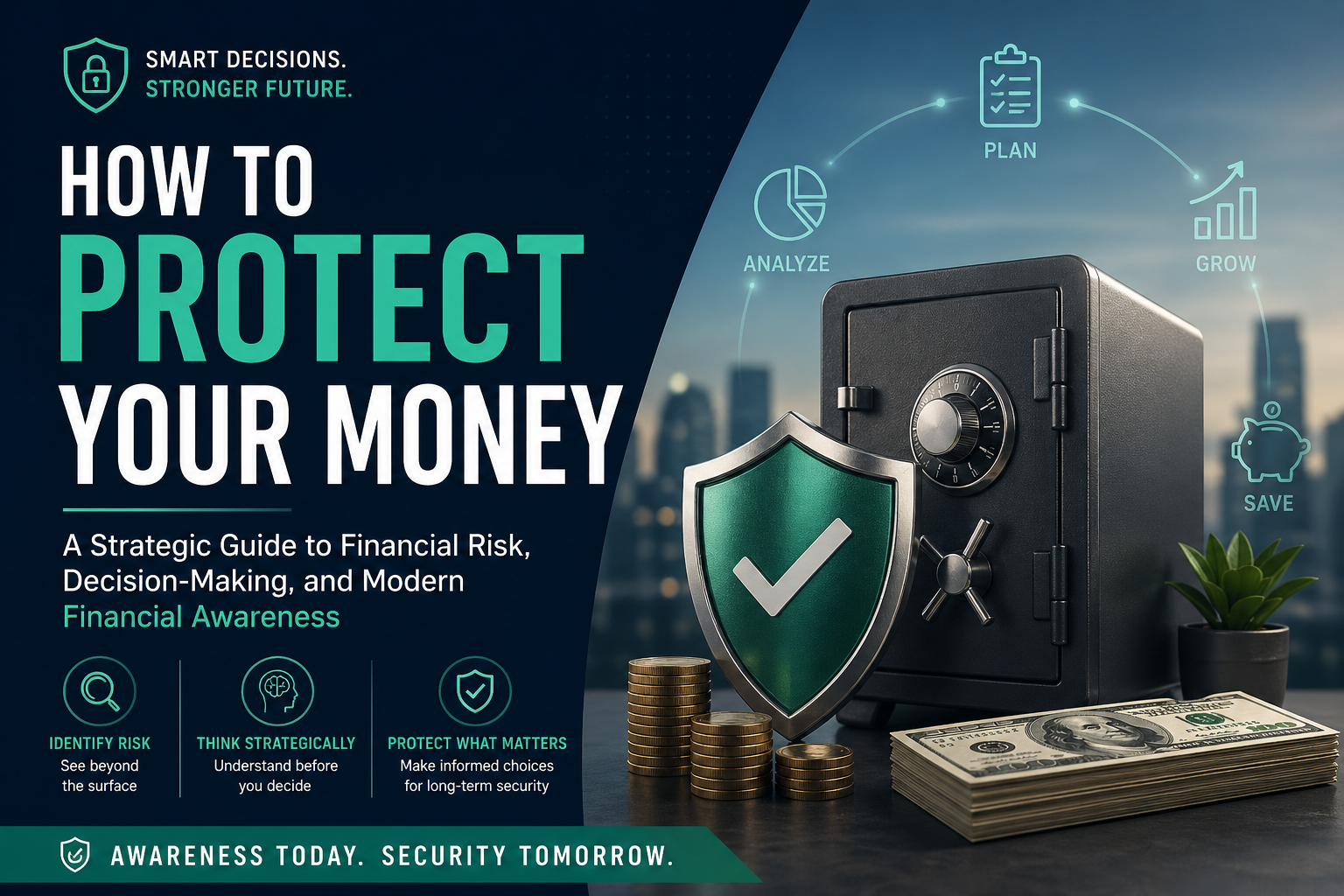
How to Protect Your Money: A Strategic Guide to Financial Risk and Smart Decision-Making
Why Protecting Your Money Is No Longer Optional
Protecting your money today isn’t just about saving, it’s about making smarter financial decisions in an increasingly complex world.
Access to financial tools has never been easier. From digital platforms to investment opportunities, everything is within reach. But with that convenience comes a hidden challenge: understanding what you’re actually getting into.
Financial loss rarely happens because of one bad decision. More often, it builds quietly, through small assumptions, overlooked risks, and misunderstood systems.
The real danger?
Not a lack of opportunity, but a misinterpretation of it.
Financial Awareness Isn’t Just Literacy, It’s Strategy
Most people believe financial awareness means knowing the basics: budgeting, saving, or investing.
But true financial awareness goes deeper. It requires:
- Understanding how financial systems actually work
- Identifying hidden or structural risks
- Questioning whether outcomes match the promises
Without this level of awareness, risk doesn’t disappear, it accumulates silently.
The Hidden Risks in Everyday Financial Decisions
Financial vulnerability doesn’t start with scams or fraud. It often begins with everyday actions, such as:
- Using financial platforms without fully understanding them
- Trusting something because it looks legitimate
- Making decisions under pressure or urgency
The issue isn’t participation, it’s participating without a clear strategy.
When “Legitimacy” Is Manufactured
One of the biggest threats in modern finance is this:
“Not everything that looks legitimate is actually safe.”
Here are common warning signs to watch for:
- Overly complex explanations that confuse rather than clarify
- Heavy focus on returns, with little mention of risks
- Lack of transparency in how things actually work
If you can’t clearly explain something, you likely don’t fully understand it, and that’s where risk begins.
A Simple Framework for Smarter Financial Decisions
Before committing to any financial decision, pause and evaluate using this framework:
1. Operational Understanding
Do you truly understand how it works?
2. Risk Identification
What are the potential downsides or losses?
3. Behavioral Awareness
Are you being influenced by pressure, urgency, or hype?
This simple shift moves you from emotional decision-making to strategic thinking.
Behavioral Traps That Increase Financial Risk
Even experienced individuals fall into psychological traps that lead to poor financial decisions:
- FOMO (Fear of Missing Out): Chasing trends without proper evaluation
- Urgency Bias: Acting too quickly without a full understanding
- Overconfidence: Assuming you know more than you actually do
Recognizing these patterns is critical.
Because in finance, behavior often matters just as much as knowledge.
Digital Finance: Convenience vs Risk
Digital finance has made managing money faster and easier—but also riskier if approached carelessly.
Before using any platform:
- Verify its legitimacy and credibility
- Understand how transactions and fees work
- Protect your personal and financial data
Convenience should never replace due diligence.
Financial Protection Is a Continuous Process
There’s no one-time fix when it comes to protecting your money.
It’s an ongoing process that involves:
- Continuous financial education
- Critical thinking and analysis
- Structured, intentional decision-making
Every informed decision you make today reduces your exposure tomorrow.
What Truly Determines Financial Outcomes
The most important distinction you can make is this:
“The difference between thinking you understand, and actually understanding.”
This difference determines whether your financial risks are:
- Managed or ignored
- Strategic or accidental

No responses yet