
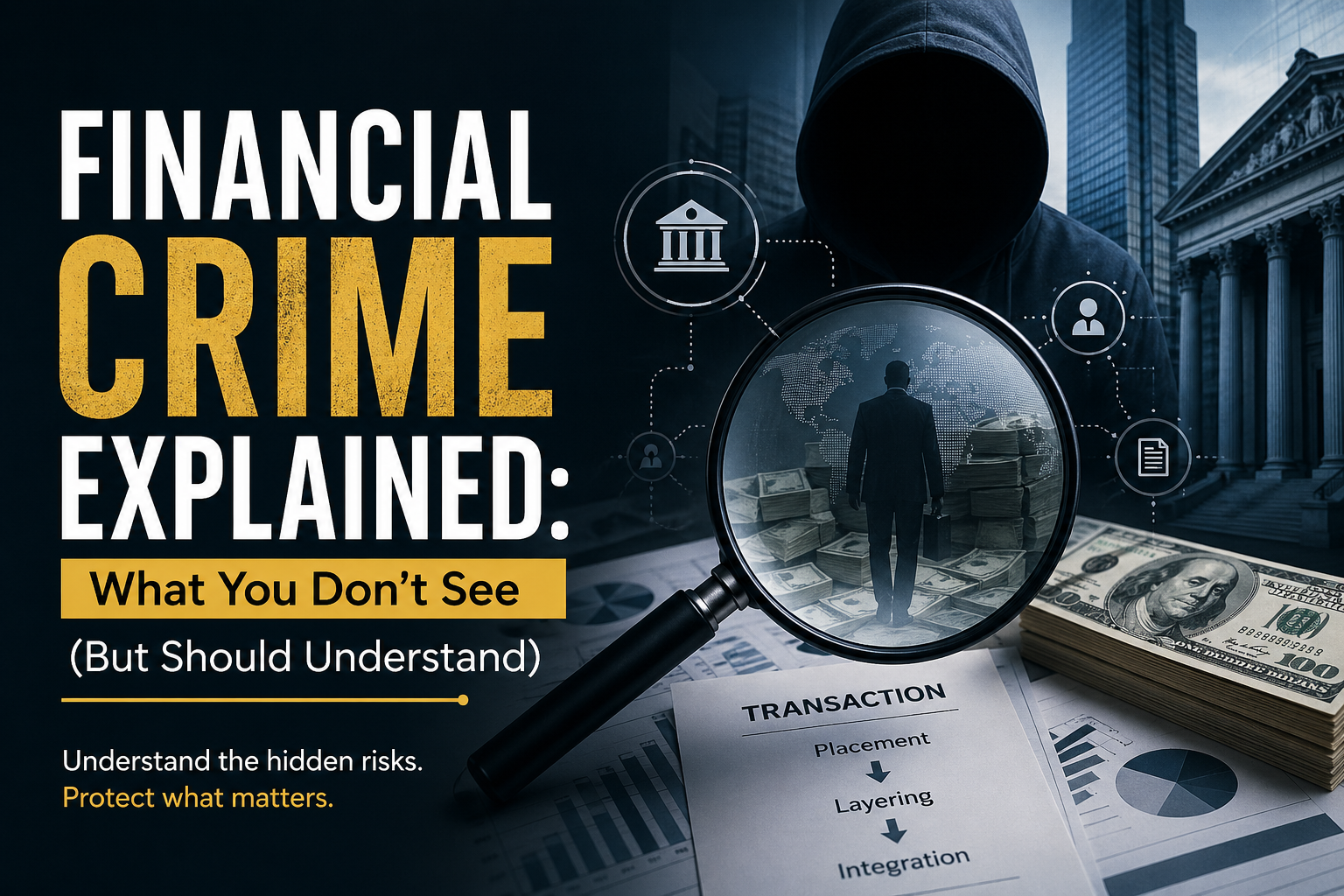
Financial Crime Explained: What You Don’t See (But Should Understand)
Financial crime is rarely obvious.
It doesn’t always look like fraud. It doesn’t always feel illegal. And most of the time, it operates in ways that appear completely normal.
That’s exactly what makes it dangerous.
In today’s complex financial systems, risk isn’t just about what’s clearly wrong, it’s about what goes unnoticed.
The Reality Most People Miss
Many people associate financial crime with extreme cases, major fraud scandals, organized criminal networks, or breaking news headlines.
But the truth is far more subtle.
Financial crime often exists within:
- Everyday transactions
- Legitimate financial systems
- Decisions that seem reasonable at the time
The real risk isn’t always visible.
It lives in what is misunderstood, overlooked, or assumed to be safe.
What Financial Crime Actually Includes
Financial crime goes far beyond scams.
It includes:
- Fraud
- Money laundering
- Insider manipulation
- Financial misrepresentation
At its core, financial crime is the misuse of systems, trust, or information for financial gain.
Understanding this broader definition is critical because many risks don’t fit the traditional “crime” narrative.
Why Financial Crime Is So Difficult to Detect
Financial crime doesn’t depend on secrecy.
It depends on appearing legitimate.
It thrives by:
- Blending into normal processes
- Using structured systems to build credibility
- Operating within trusted environments
You’ll often find it inside:
- Financial institutions
- Corporate organizations
- Digital platforms
It doesn’t stand out, it fits in.
The Structure Behind Financial Crime
Financial crime follows predictable patterns.
Take money laundering as a common example:
- Placement → Funds enter the system
- Layering → Transactions obscure the origin
- Integration → Funds appear legitimate
But this structure applies more broadly:
Entry → Movement → Justification
The activity doesn’t disappear.
It becomes indistinguishable from normal behavior.
The Hidden Risk: Unintentional Involvement
One of the most overlooked truths is this:
Not everyone involved in financial crime knows they are part of it.
Many individuals are:
- Misled by perceived credibility
- Acting on incomplete or inaccurate information
- Pressured into quick decisions
Financial risk often comes from confidence without verification.
Key Warning Signs of Financial Crime
Recognizing early signals can prevent costly mistakes.
Watch for:
- Urgency or pressure to act quickly
- Promises of guaranteed returns or outcomes
- Lack of transparency
- Overly complex or confusing explanations
- Requests for sensitive or personal information
If something cannot be explained clearly, it should not be accepted without question.
Why Regulation Matters More Than You Think
Regulation is often misunderstood as a barrier.
In reality, it is a safeguard.
It exists to:
- Maintain the integrity of financial systems
- Prevent exploitation and abuse
- Ensure accountability and transparency
Well-designed compliance frameworks don’t restrict growth, they protect it.
Awareness Is Your First Line of Defense
Financial crime doesn’t always look like crime.
It often looks like opportunity, efficiency, or routine.
That’s why awareness matters.
The more you understand how financial systems work and how they can be misused, the better equipped you are to protect yourself and others.
If you want to stay ahead of evolving financial risks and understand how compliance really works:
- Start paying closer attention to how financial systems operate
- Question anything that lacks clarity
- Continue learning about financial crime prevention and risk management
Clarity is the beginning of control.

No responses yet