
Why Periodic Reviews Are No Longer Enough
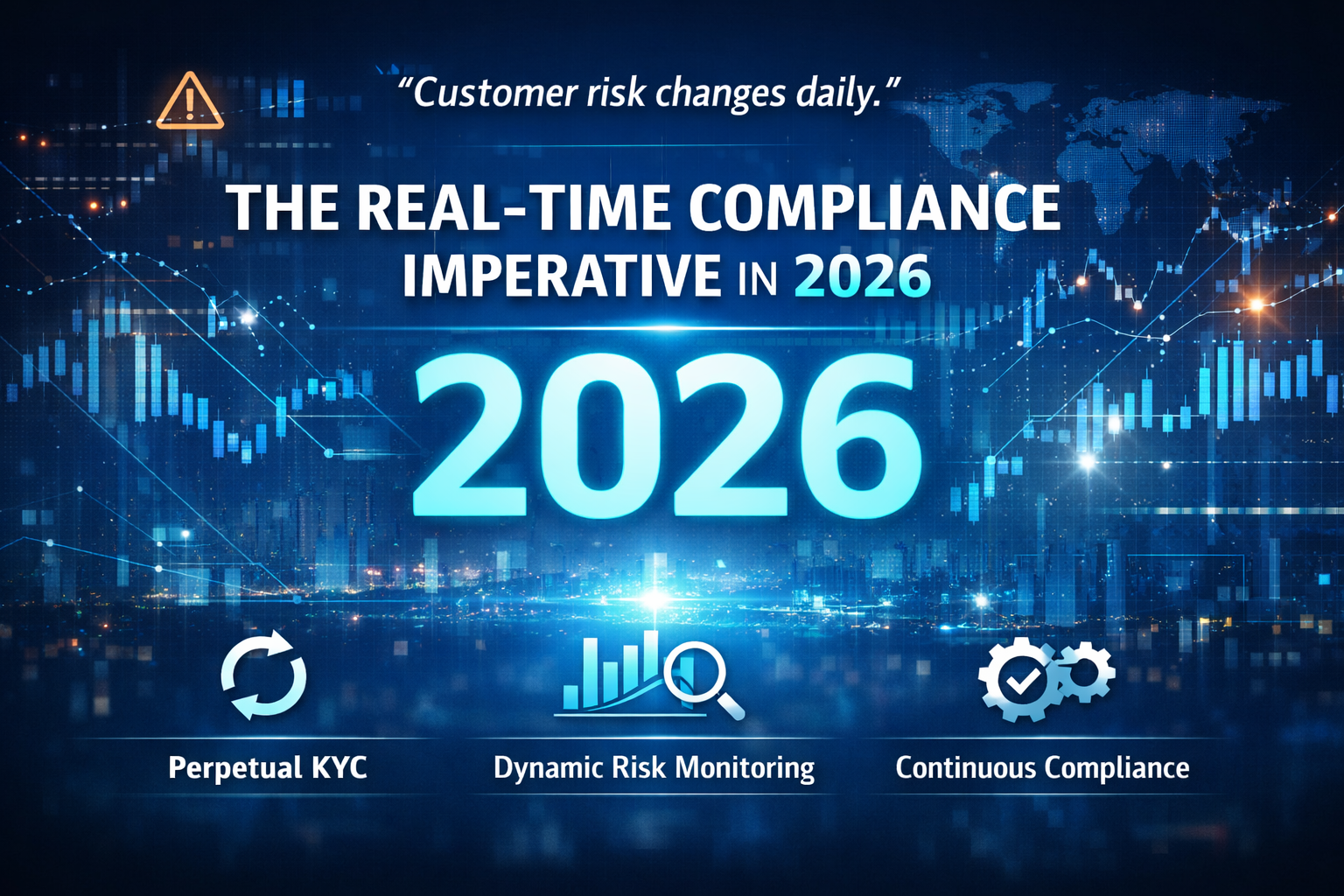
“Periodic reviews aren’t enough, customer risk changes daily.”
This statement captures the defining compliance challenge of 2026. As regulatory expectations evolve and financial crime becomes more dynamic, static compliance cycles are no longer defensible. Regulators, enforcement bodies, and risk teams are converging on a single reality: compliance must operate in real time.
Institutions that continue to rely on annual or quarterly reviews face increased regulatory exposure, operational blind spots, and reputational risk.
The Shift Toward Perpetual KYC
Traditional Know Your Customer (KYC) models were built around fixed review intervals, low risk every few years, and higher risk more frequently. In today’s environment, that approach is fundamentally misaligned with how risk actually behaves.
Perpetual KYC replaces periodic refreshes with continuous customer due diligence, driven by real-time data, behavioral monitoring, and trigger-based reviews.
In 2026, regulators increasingly expect institutions to:
- Detect material changes in customer risk as they occur
- Refresh customer profiles dynamically, not cyclically
- Demonstrate ongoing awareness of customer activity and exposure
This isn’t about reviewing more often, it’s about reviewing intelligently and continuously.
Risk Moves Faster Than Fixed Compliance Cycles
Customer risk no longer changes slowly. It can shift overnight due to:
- Sanctions updates or geopolitical developments
- Changes in ownership, control, or beneficial owners
- New transaction behaviors or product usage
- Exposure to high-risk jurisdictions or counterparties
Fixed review cycles create risk latency, the dangerous gap between when risk changes and when it’s identified.
In enforcement actions, regulators are increasingly asking not when the last review was completed, but why the institution failed to act when risk indicators emerged.
Continuous Compliance Requires More Than Technology
While automation is essential, tools alone do not equal compliance.
Effective real-time compliance sits at the intersection of:
1. Technology
- Transaction monitoring with adaptive thresholds
- Event-driven KYC refreshes
- Integrated screening and adverse media monitoring
2. Governance
- Clear ownership of ongoing risk decisions
- Escalation frameworks aligned to dynamic risk
- Board-level understanding of continuous compliance models
3. Processes
- Defined triggers for customer review and reclassification
- Documentation that supports regulatory defensibility
- Workforce enablement to interpret and act on real-time alerts
Without strong governance and process design, even the most advanced systems fail under regulatory scrutiny.
Why 2026 Is the Tipping Point
According to industry analysis from KYC360, supervisory focus is shifting decisively toward:
- Continuous risk assessment
- Data-driven compliance decisions
- Evidence of proactive, not reactive, controls
Institutions that delay modernization risk falling behind both regulatory expectations and peer benchmarks.
Final Thought: What’s Your Compliance Rhythm?
Real-time compliance is not about speed alone, it’s about alignment with how risk truly behaves.Read the full industry outlook, then ask yourself:
Is your compliance framework moving at the pace of your customers’ risk, or lagging behind it?

No responses yet