
Key points:
- SpaceX shares slide 8%
- Revenue hits $7.8 billion
- AI spending target raised
Elon Musk’s rocket maker nearly doubled its revenue but it also more than doubled its spending on AI.
🚀 Debut numbers clear expectations
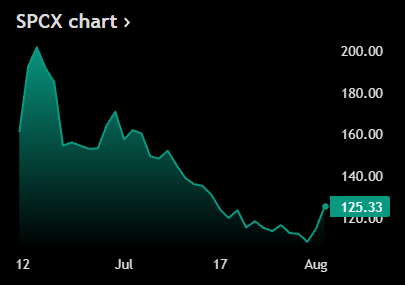
- SpaceX shares SPCX fell as much as 8% after its first public earnings report on Tuesday. The company delivered the growth investors wanted, but paired it with blockbuster AI spending.
- The rocket launched cleanly. Wall Street became considerably less enthusiastic during the landing sequence.
- Second-quarter revenue surged 92% year over year to $7.8 billion, comfortably beating analysts’ $6.8 billion forecast. The net loss narrowed to roughly $541 million, far better than the expected $2.1 billion. On traditional earnings metrics, SpaceX decisively cleared the tower.
- The report followed June’s historic $86 billion IPO, initially sending SpaceX shares toward $225.
- They have since lost almost half their value, leaving the company worth around $1.65 trillion. Public markets welcomed Musk to quarterly reporting with their traditional gift: immediate judgment.
🧠 AI ambition produces a giant bill
- SpaceX spent almost $16 billion on AI infrastructure during the quarter, more than double the previous period and well above Wall Street’s forecast.
- Capital expenditure, or capex, covers long-term assets such as data centers and chips. SpaceX is purchasing both at interplanetary scale.
- Management said AI spending would remain near current levels for at least two more quarters. Musk plans to expand computing capacity from 2 gigawatts by year-end to closer to 10 than 5 gigawatts by late 2027. Each additional gigawatt can cost tens of billions.
- At 10 gigawatts, SpaceX’s data centers could consume roughly as much electricity as New York City during peak summer demand.
- Musk also committed future infrastructure exclusively to Nvidia hardware, giving Blackwell and its successors the contract while leaving AMD outside mission control.
🌌 Musk aims for the trillion-dollar year
- SpaceX’s valuation rests on several modest little objectives: reusable missions to Mars, orbital data centers, global satellite connectivity and a leading role in AI. That’s several industries that barely exist.
- Tesla is increasingly collaborating with SpaceX, including through Terafab, a proposed semiconductor manufacturing initiative.
- That overlap could help Musk secure chips and infrastructure internally, though it also ties two enormously valuable companies more closely to the same capital-intensive AI wager.
- Musk expects SpaceX to generate $1 trillion in annual sales by 2030, one year earlier than previously forecast, with a “non-zero” chance of reaching it in 2029. Quarterly revenue is currently $7.8 billion. Ambitious is one word. Vertical is another.
Source: Tradingview

No responses yet