
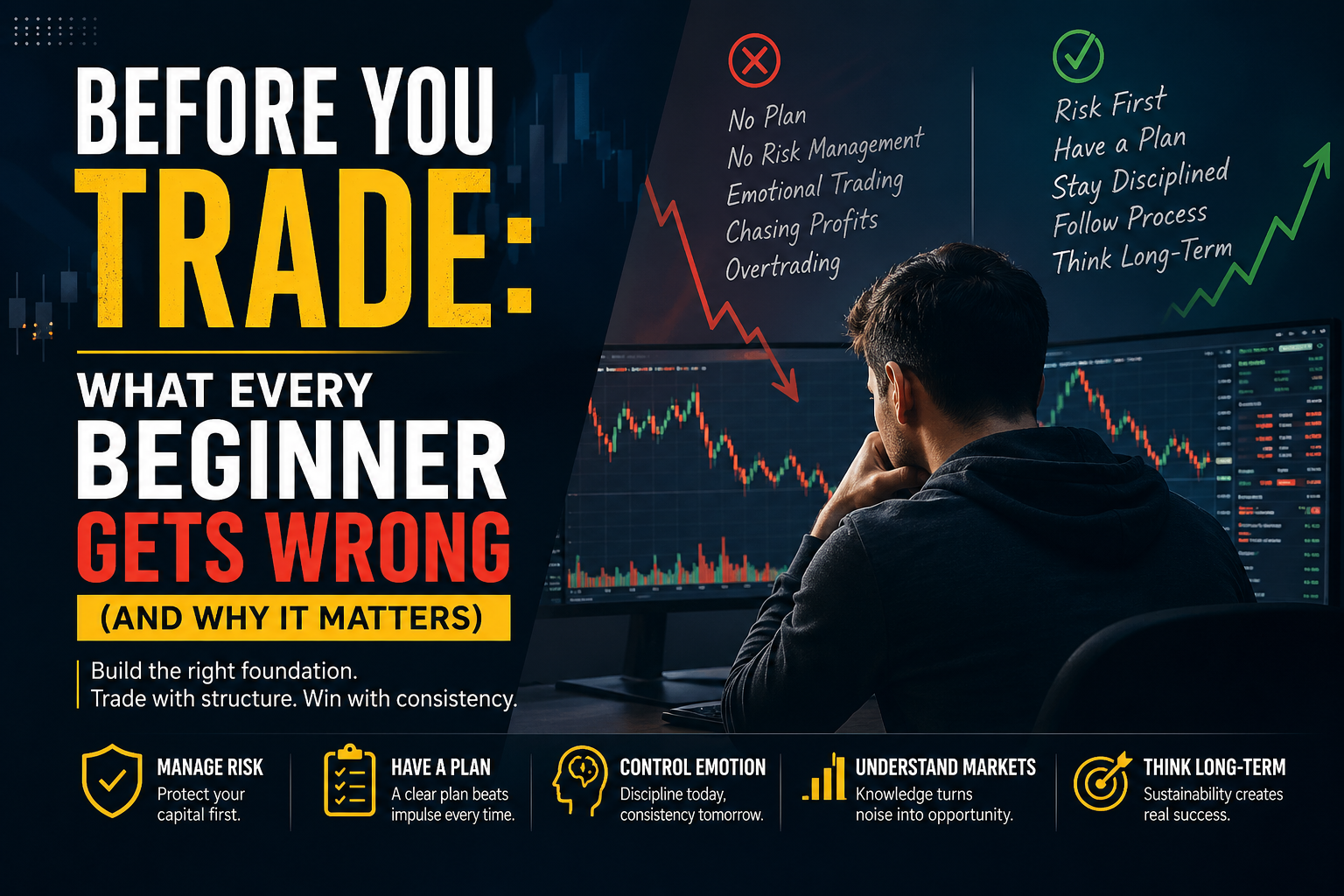
Before You Trade: What Every Beginner Gets Wrong (And Why It Matters)
The Hidden Risk Behind Beginner Trading
Most people step into trading thinking it’s an opportunity.
An opportunity for:
- Financial independence
- Fast income
- Easy access to markets
But here’s the truth most don’t realize:
Participation without understanding doesn’t create opportunity, it increases risk.
This is where beginner traders go wrong.
Not because trading is impossible to learn…
But they enter without structure, strategy, or risk awareness.
Trading Is Not About Winning
Many beginners see trading as a simple equation:
Win = Profit
Lose = Failure
But real trading doesn’t work like that.
At its core, trading is built on:
- Decision-making under uncertainty
- Probability-based outcomes
- Risk management
It’s not about prediction.
It’s not about certainty.
It’s about managing exposure in an unpredictable system.
Why Most Beginner Traders Fail
The failure isn’t random, it follows a pattern.
Most beginners:
- Expect fast profits
- Trade without a clear system
- Ignore risk exposure
The result?
Inconsistency → Emotional decisions → Compounding losses
This isn’t bad luck.
It’s a structural problem.
The Illusion of Trading Success
What you usually see online:
- Big profits
- Winning streaks
- Fast gains
What’s rarely shown:
- Drawdowns
- Long-term losses
- Emotional pressure
- Strict discipline
This creates a dangerous misconception.
It shifts focus from:
- Process → Results
- Discipline → Speed
And that shift is where most traders lose control.
Risk Management in Trading: The Real First Step
Here’s the mindset shift every beginner needs:
Trading is not about making money.
It’s about managing risk.
Before entering any trade, ask:
“What is my risk if this goes wrong?”
Without this:
- Losses compound quickly
- Decisions become reactive
- Capital becomes vulnerable
Profit is not something you chase.
It’s the byproduct of consistent risk management.
Trading Psychology: It’s Not About Emotion
Many assume emotional trading is the problem.
It’s not.
The real issue is the lack of structure.
Without a framework:
- Decisions become impulsive
- Losses trigger overtrading
- Discipline breaks down
Structure doesn’t remove emotion, it controls its impact.
Markets Are Driven, Not Random
Markets may feel chaotic, but they’re not random.
They are influenced by:
- Supply and demand
- Market sentiment
- Economic data
- Institutional activity
Without understanding these forces:
You’re not trading, you’re reacting.
And reaction is not a strategy.
Trading Strategy Basics: Build Your Foundation First
Before using any strategy, every trader needs:
- A clear risk management plan
- A repeatable trading process
- Basic market understanding
- Structured decision-making rules
Without these:
Success isn’t delayed, it’s impossible.
Sustainability Over Short-Term Wins
Long-term trading success isn’t about:
- Winning frequently
- Hitting quick profits
It’s about:
- Managing downside risk
- Protecting capital
- Staying consistent over time
Consistency beats intensity, every time.
Slow Down Before You Trade
Trading isn’t about jumping in quickly.
It’s about stepping back and building the right foundation first.
Because without:
- Structure
- Knowledge
- Discipline
Trading stops being an opportunity… and becomes pure exposure.
If you’re serious about trading, don’t start with strategies.
Start with structure.
- Learn risk management first
- Build a repeatable process
- Focus on consistency, not quick wins
Because the traders who last…are the ones who prepare.

No responses yet