
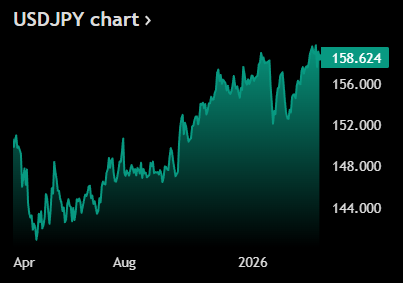
Key points:
- Dollar-yen hits session high of ¥159.80
- ¥160.00 intervention threshold in sight
- Resistance looms at ¥160.50 channel boundary
Japan’s economy is looking at fresh pressures as it imports virtually all of its oil and gas. And these two are hot commodities right now.
🗾 ¥159.80 and Climbing. ¥160 Ahead?
- The USD/JPY pair pushed to a session high of ¥159.80 early Monday as war jitters reshuffled FX priorities and dollar demand reasserted itself across the board.
- The pair is chasing the ¥160.00 level, a threshold that Japanese monetary authorities have previously used as a trigger point for intervention or intervention threats. Every tick above ¥159.50 is a tick into territory that makes Tokyo uncomfortable.
- Currency intervention occurs when a central bank or finance ministry directly buys or sells its own currency in the open market to influence the exchange rate. Japan has intervened multiple times in recent years when the dollar-yen approached or exceeded ¥160.
- The previous intervention zone sits at ¥161.90, hit in early July, giving the current move a clear historical reference point. Markets are not in uncharted territory yet, but they are approaching the outer boundary of where Japan has historically tolerated dollar strength before acting.
📐 The Technical Picture Has a Ceiling
- Beyond the ¥160.00 psychological level, the more precise technical resistance sits at ¥160.50, where the upper boundary of a descending channel is expected to cap the advance.
- Descending channels form when an asset makes a series of lower highs and lower lows contained within two parallel downward-sloping lines. The upper boundary represents where sellers have consistently overwhelmed buyers in prior attempts to break higher.
- Resistance at a channel boundary combined with a known intervention threshold in the same price zone creates a double ceiling that is technically and politically reinforced.
- A rejection at ¥160.50 would confirm that structure remains intact and that the current move is a rally within a broader range rather than a breakout to new highs.
⛽ Japan’s Oil Problem Is the Yen’s Problem
- The fundamental driver behind yen weakness right now is straightforward and structurally punishing. Japan imports virtually all of its oil and natural gas, meaning the country must convert yen into dollars to pay for energy on global markets.
- When oil sits near $113 a barrel and gas prices are surging, Japan’s import bill expands dramatically, creating sustained mechanical selling pressure on the yen that no amount of verbal intervention fully offsets.
- The current account dynamic matters here. Japan’s trade balance deteriorates when energy prices spike because import costs rise faster than export revenues can compensate.
- A weaker current account means less demand for yen from overseas buyers of Japanese goods, removing one of the natural support mechanisms that typically cushions the currency during periods of global stress.
- The Bank of Japan finds itself in an increasingly uncomfortable position. Rate hikes would strengthen the yen and ease import cost pressures, but they would also slow an economy already absorbing an energy shock it did not choose.
Source: Tradingview

No responses yet